.cnn_html_media_utility::before{color:red;content:'>>';font-size:9px;line-height:12px;padding-right:1px}
.cnnstrylccimg640{margin:0 27px 14px 0}
.captionText{filter:alpha(opacity=100);opacity:1}
.cnn_html_slideshow_media_caption a,.cnn_html_slideshow_media_caption a:visited,.cnn_html_slideshow_media_caption a:link,.captionText a,.captionText a:visited,.captiontext a:link{color:outline:medium none}
.cnnVerticalGalleryPhoto{margin:0 auto;padding-right:68px;width:270px}
]]>
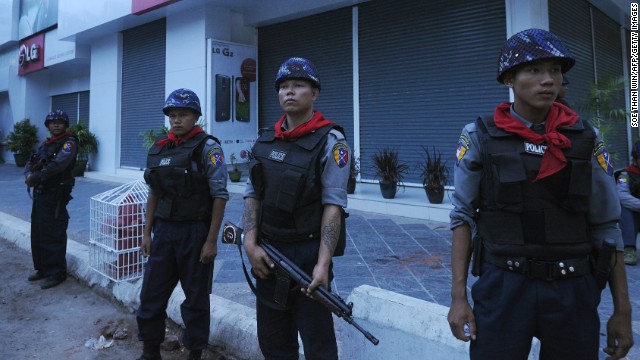 Myanmar police guard on a street in Mandalay, after imposing an overnight curfew in the country's second largest city. The curfew was introduced after two nights of religious violence between Buddhists and Muslims that left two people dead.
 Mourners at the funeral of a victim of the unrest. The violence started at a tea shop owned by a Muslim accused of raping a Buddhist woman, and involved mobs of hundreds of people, some of them armed.
 Family members grieve next to the man's coffin.
 Ko Htwe, who was injured in the riots, sits next to his friend's coffin. Officials say 14 people were injured in the unrest.
 Two Muslims ride past officers imposing order in the streets of Mandalay, Myanmar's multicultural, multi-faith second city. Muslims, who comprise about 5% of Myanmar's population, have been the target of occasional mob violence at the hands of the country's Buddhist majority in recent years,
 Buddhists monks read newspapers at a monastery in Mandalay. Radical Buddhist monks, including the nationalist 969 Movement's spiritual leader Ashin Wirathu, have been accused of helping to incite the violence.
1

2

3

4

5

6
(CNN) -- Authorities have imposed a curfew in Mandalay, Myanmar's second-largest city, following nights of deadly communal violence between Buddhists and Muslims.
Two people have been killed and 14 injured since rioting erupted Tuesday, Col. Aung Kyaw Moe, Mandalay's Region border affairs and Security Minister tells CNN.
The rioting began when a mob began attacking a tea shop owned by a Muslim man accused of raping a Buddhist woman, and continued the following night.
The newspaper said eight separate conflicts took place in the region over two nights, involving gangs of as many as 450 people, some armed with weapons including swords, firearms, knives, rods and "incendiary materials," citing officials.
One of the victims was Muslim and one Buddhist, officials said. Myanmar is a predominantly Buddhist country, with Muslims estimated to account for about 5% of the population.
Myanmar has witnessed several outbreaks of violence targeting Muslims in recent years as the country emerges from decades of authoritarian military rule, threatening the country's fragile political reforms.
Extremist Buddhist nationalist elements, such as the 969 Movement, have been accused of fanning the flames of hatred, and pushing for discriminatory laws, including a proposed ban on interfaith marriage.
Fears of new unrest as Myanmar ponders monk-backed interfaith marriage ban
Radical Buddhist monks, including the 969 Movement's spiritual leader, Ashin Wirathu, appeared to have played "a pivotal role" in contributing to the latest unrest, said David Mathieson, a senior researcher for Human Rights Watch.
Anger against the Muslim tea shop owner, a Muslim, had escalated after Wirathu had circulated a report of the alleged rape on his Facebook page, and called for a harsh government response to "jihadist Muslims."
There had been a significant monk presence among the mob, said Mathieson.
"The area where this happened is 5-10 minute drive from where Wirathu's monastery is," he said. "This really is his heartland."
Activists in Myanmar have campaigned against online hate speech on social media, particularly anti-Muslim rhetoric which they blame for contributing to the violence against the minority.
Religious violence has left hundreds of people dead and close to 150,000 homeless since unrest broke out in in the western state of Rakhine in June 2012, with the stateless Rohingya Muslim minority bearing the brunt of the violence. Outbreaks of anti-Muslim violence have occurred elsewhere in the country.
Aung said nine people had been arrested over the violence. Five were Muslim and four Buddhist, he said.
Aung San Suu Kyi's silence on the Rohingya
Nien Chan contributed to this report.
http://www.information.myanmaronlinecentre.com/myanmar-curfew-after-deadly-clashes/

No comments:
Post a Comment